💬 From the Counseling Office
Updated: 4 days ago
The Student Who Showed Me I Was Exactly Where I Needed to Be
If you had asked me ten years ago what grade level I would eventually work with as a school counselor, I can promise you one answer you would never have heard.
Middle school.
It simply wasn't part of the plan.
I had experience with elementary students. Before that, I had spent twelve years serving in the military, working with young adults as a military intelligence analyst, sexual assault victim advocate, and Drug and Alcohol Program Advisor. Naturally, I assumed my future would be in either an elementary school or a high school.
Middle school?
Absolutely not.
Or so I thought.
Funny how life has a way of rewriting our plans.
When I accepted my first counseling position at a middle school, I was excited—but if I'm being completely honest, I was also nervous. Middle schoolers had a reputation. People warned me they were emotional, unpredictable, awkward, dramatic, and constantly testing boundaries.
They weren't wrong.
But they also forgot to tell me something else.
Middle school students are incredibly honest.
They're trying to figure out who they are while living somewhere between childhood and adulthood. One minute they want independence, and the next they still need someone to remind them that they're going to be okay.
They're funny.
They're resilient.
They're brave in ways they don't even recognize.
And they're often carrying far more than adults realize.
It didn't take long before one particular student walked into my office and unknowingly changed the way I viewed my new role.
Without sharing the details of their story, I can tell you they were struggling. Their behavior had become the focus of almost every conversation adults were having about them. It seemed as though everyone had an opinion about what they were doing wrong.
As I listened, I caught myself wondering what intervention would "fix" the situation.
Then the student said something I'll never forget.
"I'm tired of everyone thinking I'm a bad kid."
That sentence stopped me.
Because underneath every behavior was a child who desperately wanted someone to see more than the referral, the missing assignments, or the poor choices.
In that moment, I realized something important.
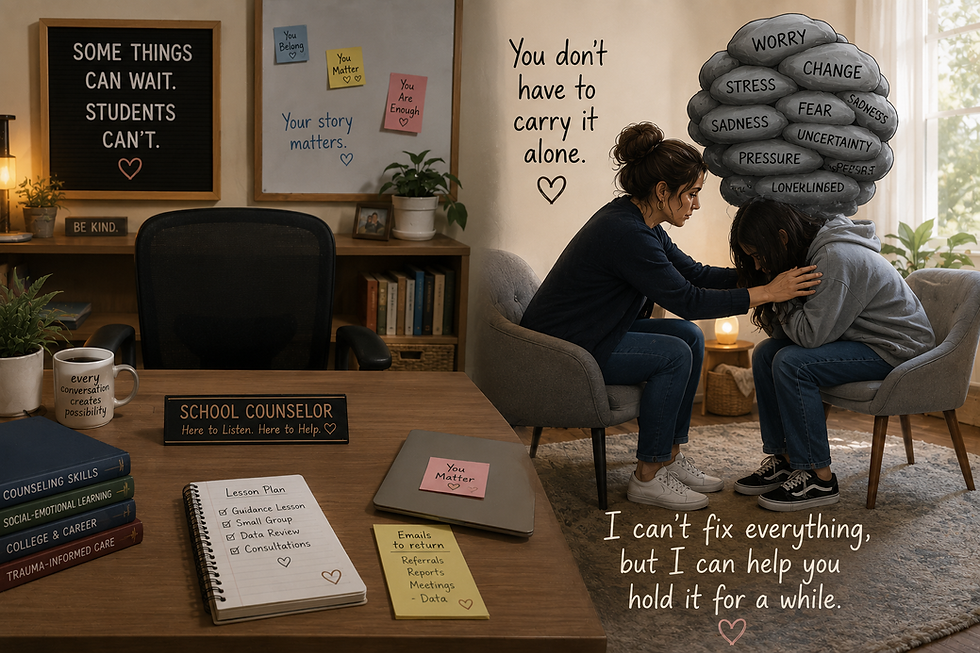
My job wasn't to fix students.
My job was to help them see that they were never broken to begin with.
That student reminded me that behavior is only one chapter of a student's story—not the entire book.
As the weeks went on, we stopped spending so much time talking about what wasn't working. Instead, we looked for moments when things went just a little better. We celebrated small victories. We noticed strengths. We built from those successes.
The changes didn't happen overnight.
Real growth rarely does.
But slowly, the student began seeing themselves differently.
And if I'm honest, so did I.
I had spent so much time wondering if middle school was the right place for me.
It turns out it was exactly where I was supposed to be.
Sometimes the students who challenge us the most are the very ones who teach us why we chose this profession.
They remind us that every student is more than their hardest day.
More than their behavior.
More than a data point.
More than someone else's opinion.
That first year taught me something I'll carry with me throughout my career.
Sometimes God doesn't send us where we're comfortable.
He sends us where we're needed.
And every once in a while, a student comes along who quietly reminds us that we are exactly where we need to be.
📓 Lessons from the Office
Every student leaves us with a lesson if we're willing to notice it. Here are the ones I'm taking with me from this story:
Students are more than their behavior. A discipline referral may explain what happened, but it never tells the whole story.
The students who challenge us the most often become our greatest teachers. They stretch our patience, deepen our compassion, and remind us why relationships matter.
The path we never planned may be the one we were meant to walk. I never imagined becoming a middle school counselor, yet this age group has taught me more about hope, resilience, and growth than I ever expected.
Growth begins when someone chooses to see potential instead of problems. Sometimes the most powerful intervention is helping a student recognize strengths they didn't know they had.
Counseling isn't about fixing students. It's about creating the conditions where students can discover they already have the capacity to grow.
🌱 This Week's Reflection
Before you begin next week, take a moment to think about the student who has challenged you the most this year.
Then ask yourself:
What has that student taught me about becoming a better educator?
Sometimes our greatest professional lessons don't come from our easiest students.
They come from the ones who quietly change us.
Until next time...
Keep asking better questions.
Keep looking for strengths.
Keep building hope.
And above all...
Keep working on what works.



Comments