When We Lose a Student: Supporting Others While Navigating Our Own Grief
There are things they prepare us for in graduate school. We learn about crisis intervention, suicide prevention, mandated reporting, trauma-informed care, and how to support students through some of the hardest moments of their lives.
But there is something no school counselor is ever truly ready for: losing a student.
Maybe you have experienced this as a teacher. Maybe you haven't. But when you experience it as a school counselor, it takes on a whole new meaning.
Suddenly, you are not just grieving the loss of a student. You are also helping other students process what happened, supporting teachers who may be struggling to find the right words, answering questions from staff, and helping the school navigate a situation that can feel overwhelming for everyone involved.
And somewhere in the middle of all of that, you are expected to keep showing up.
Because you are the counselor, right?
You are the person people look to when they don't know what to say or what to do next. You are the one who is supposed to have the resources, the plan, and the answers.
But here is the thing: you are human, too.
And we need to talk about that.

Before You Support Everyone Else, Check In With Yourself
Let's start here because this matters.
When a student dies, it can be easy to jump straight into problem-solving mode. Who needs to be notified? What do we tell the students? Which teachers need support? Where should we set up? What resources do we need?
There is a lot to do, and the needs of the school community are real.
But so are yours.
Maybe you knew the student well. Maybe you had them in your office last week.
Maybe you remember a conversation, a laugh, or a moment when they finally opened up to you. Maybe you didn't know them personally, but the loss still hits you in a way you weren't expecting.
Whatever your connection to the student, your feelings are valid.
It is okay to be sad. It is okay to feel shocked, angry, confused, or overwhelmed. It is okay to have moments when you need to step away and collect yourself.
You do not have to prove your professionalism by pretending you aren't affected.
Being a counselor does not mean being untouched by the things we help others navigate.
Start by identifying your own support system. Does your district have a crisis response team? Is there a counselor, supervisor, colleague, or mental health professional you can talk with? Are there established supports available to help staff process the loss?
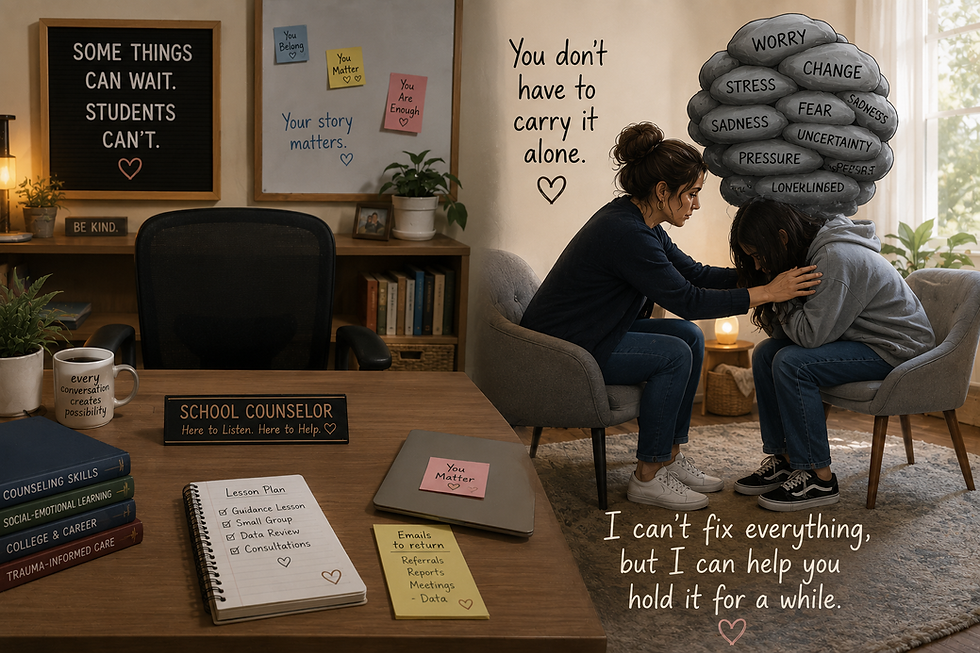
If your district has a team that responds to these situations, use that resource. You do not have to carry this alone.
And please remember that supporting others does not mean ignoring your own grief.
We talk a lot about not being able to pour from an empty cup, but this is one of those moments when that reminder really matters.
Check in with yourself. Take a breath. Ask for help.
You deserve support, too.
Have a Plan Before You Need One
Now, let's talk about the students.
First things first: if your district has a protocol for responding to the death of a student, follow it. These situations require coordination, and there may be district procedures related to communication, crisis response, family contact, and student support.
If your district does not have a clear protocol, I encourage you to start a conversation about creating one. Work with your administrators and appropriate district personnel to establish a plan before you find yourself in the middle of a crisis.
Trust me, trying to figure everything out while everyone is looking to you for answers is not where you want to be.
No matter what your response process looks like, one priority should remain at the center of your work: making sure students have access to support when they need it.
Here are some things I have found helpful when thinking through that process.
1. Communicate With the Family
When appropriate and in coordination with administration, connect with the student's family to offer condolences and determine what information they are comfortable having shared with the school community.
What would they like students and staff to know? Are there details they would prefer to keep private? Are there cultural or family considerations that need to be respected?
We may be responsible for supporting the school community, but the family is experiencing an unimaginable loss. Their privacy and wishes matter.
Coordinate with district leadership on what can be communicated, and share only confirmed, authorized information. We do not need to know or share every detail to support our students.
2. Establish a Space for Support
Choose a location where students and staff can come for support throughout the day.
Make sure staff members know where the space is and who will be available to help.
If possible, organize a small team of trained staff members who can help respond to students, provide support in classrooms, and manage the different needs that may arise.
I also like to have paper, markers, colored pencils, and other drawing and writing supplies available.
Sometimes students need to talk. Sometimes they need to sit quietly. Sometimes they want to write a letter to the family, share a memory, or draw a picture.
Giving students different ways to express themselves can help them communicate when they don't quite have the words.
If letters or drawings will be shared with the family, screen them beforehand and follow your school's procedures for handling and sharing these items. This helps ensure that the materials being passed along are appropriate and do not unintentionally cause additional harm.
And remember, not every student will want to participate in the same way. We are creating opportunities for expression, not requiring it.
3. Walk the Student's Schedule
One approach I have used is to work with a small team and walk through the student's schedule.
Rather than making one large announcement and expecting every student to process the information in the same way, we go to the classrooms the student attended and share the information with those students directly.
Of course, this should be coordinated with administration and follow district protocol.
The information shared will depend on what has been confirmed and what the family and district have authorized.
We tell students what we can, acknowledge that they may have different reactions, and let them know where support is available throughout the day.
Most importantly, we give them a choice.
They can come talk to someone right away, or they can come later. They can stay in class if they feel able, or they can ask for support if they need it.
We make sure they know where we are and that they do not have to figure out their next step alone.
Students may have questions we cannot answer. They may cry, become quiet, seem unaffected, or react in ways we did not anticipate.
There is no single correct way to respond to grief.
Our job is not to make every student react a certain way. Our job is to create a safe, supportive environment where they can have their own reactions and know that help is available.
4. Make Space for Memories
When students come in to talk, I like to gently guide the conversation toward memories of the student.
Tell me a favorite story.
What is something you liked about them?
What is something they did that made you laugh?
What is a memory you want to hold on to?
These questions can help students talk about the person they knew, rather than focusing only on the fact that the person is gone.
This is not about forcing students to find a positive in a painful situation. It is about making room for the relationship, the memories, and the ways that person mattered.
Some students will have happy memories. Others may have complicated relationships or feelings they don't know how to make sense of. We need to make room for those experiences, too, without telling students how they should feel.
We also need to be mindful of the circumstances surrounding the death. If the death involved suicide or another traumatic circumstance, follow your district's postvention procedures and use appropriate, evidence-informed guidance. Avoid sharing unnecessary details or unintentionally romanticizing the death.
We can honor a student's life without making the circumstances of their death the center of every conversation.
Sometimes, a simple question and a willingness to listen are enough to help a student begin talking.
And sometimes, the most important thing we can do is sit with them while they find the words.
Remember: You Don't Have to Have All the Answers
One of the hardest parts of this work is that we want to help. We want to make things better. We want to take away the hurt our students are experiencing.
But grief does not work that way.
We cannot undo what happened. We cannot answer every question. We cannot promise that everything will be okay.
What we can do is show up.
We can listen without rushing to fix. We can acknowledge that something is painful without trying to explain it away. We can remind students that they are not alone and connect them with support when they need more than we can provide in a brief conversation.
We can watch for students who may need additional help, including those who were especially close to the student or who have experienced previous losses. We can collaborate with families and mental health professionals when concerns arise, and we can continue checking in after the initial crisis has passed.
Because grief does not follow the school calendar.
The first day back may be difficult. So might the first birthday, the first school event, or a day when an unexpected memory brings everything back.
Our support cannot end simply because the immediate crisis response is over.
A Final Thought for My Fellow School Counselors
If you have experienced the loss of a student, I hope you know that you do not have to carry that experience alone.
You can be a strong counselor and still need support. You can help your students navigate grief while acknowledging your own. You can be the person everyone turns to and still need someone to check in on you.
Those things are not contradictory. They are human.
We spend so much time talking about how to create safe spaces for our students. We remind them that they matter, that their feelings matter, and that asking for help is a sign of strength.
We need to extend that same compassion to ourselves and to the colleagues walking through this experience beside us.
We may not be able to take away the pain of losing a student. But we can help ensure that the students and staff left behind have people who will listen, spaces where they can grieve, and opportunities to remember the life that was part of their school community.
And when we are ready, we can keep showing up for one another, too.
If your school experienced this loss tomorrow, would you know who to call, where to go, and how to support both your students and yourself?
Until next time, remember… Every Conversation Creates Possibility.


Comments