Testing Season: From Counting Ceiling Tiles to Calming Minds

If you’ve ever been a classroom teacher during state testing, you know the feeling.
You’re standing in a room for hours. Silence. No teaching. No talking. Just… monitoring.
You start counting ceiling tiles.
Then you start recounting ceiling tiles because you lost track at 47.
You read every poster on the wall like it’s a bestselling novel.
You’ve sung at least three full albums in your head.
And somehow… only 12 minutes have passed.
You’re just waiting for that testing clock to wind down so you can be released back into the real world.
Fast forward.
Now you’re the school counselor.
And while you might still be passing out materials, walking hallways, or giving teachers a much-needed break… your role during testing season looks very different.
Because now?
You’re the landing spot for anxiety.
The Counseling Office During Testing Season

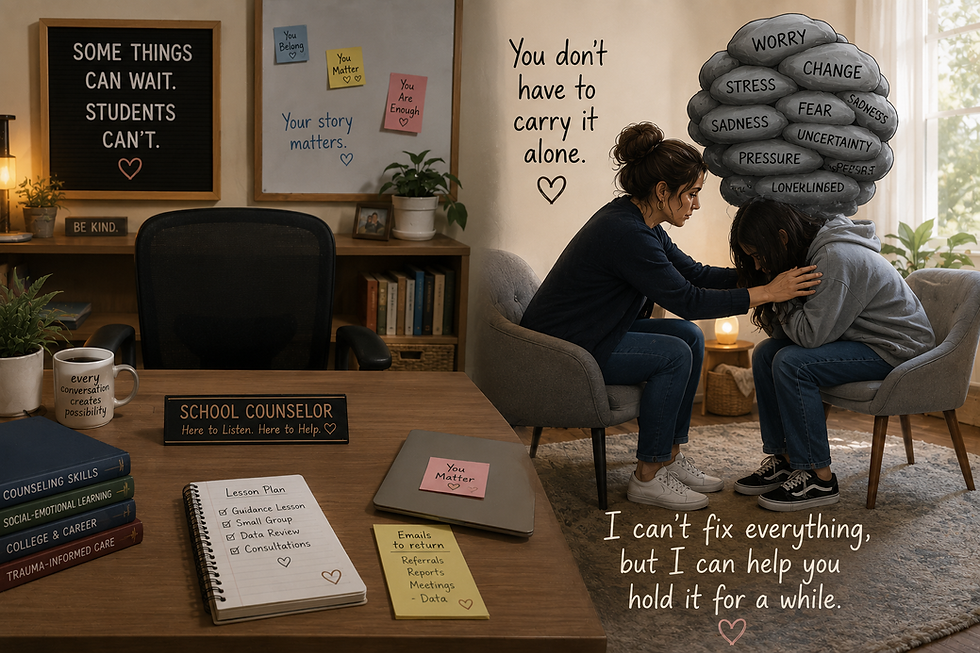
During testing days, your office fills up with students who suddenly feel overwhelmed, panicked, or completely shut down.
And here’s the part that often surprises people:
It’s not always the students you expect.
Some of your highest-achieving, gifted, and “always fine” students are the ones struggling the most.
Why?
They carry a lot of expectations (from themselves, parents, and teachers)
They’re not used to struggling
Many have never actually had to learn how to study
Their identity is often tied to “being the smart one”
So when a high-stakes test shows up?
It’s not just a test. It feels like a threat.
When a Student Shuts Down: A Solution-Focused Lens
So what do you do when a student walks in, wide-eyed, overwhelmed, maybe on the verge of a panic attack?
This is where a solution-focused approach becomes your best friend.
Instead of diving deep into the panic, we gently guide them toward what’s already worked.
Start Here: “What’s Worked Before?”
“Have you ever felt nervous before a test and still gotten through it?”
“What did you do that helped even a little?”
“What’s one thing that kept it from getting worse?”
Even if they say, “I don’t know,”—stay with it.
There’s always something.
Build on Their Strengths
Once they identify even the tiniest success, expand it:
“How did you make yourself do that?”
“What does that say about you?”
“How could you use that again today?”
You’re helping them see:
👉 They already have tools.
👉 This isn’t their first hard moment.
Scale It Down
Testing anxiety can feel like a 10/10.
Try scaling:
“On a scale from 1–10, where are you right now?”
“What would make it a 6 instead of a 7?”
We’re not aiming for zero anxiety (not realistic during testing week 😅).
We’re aiming for manageable.
Create a Tiny, Doable Plan
Keep it simple. Think first step, not full transformation:
“What’s the first thing you’ll do when you sit down?”
“What will you tell yourself if you get stuck?”
“What does ‘just enough to start’ look like?”
Sometimes the plan is as small as:
👉 “I’ll read the first question and take one deep breath.”
And that counts.
Normalize + Reframe
Let’s be honest—testing season is a lot.
You can say things like:
“It makes sense your brain is reacting this way—this feels important.”
“Your body is trying to help you, even if it feels uncomfortable.”
“You don’t have to feel calm to still do the test.”
That last one? Gold.
Don’t Forget the Quiet Wins
Not every student will walk out saying, “Wow, I feel amazing!”
But if they:
Go back to class
Sit down
Start the test
That’s a win.
A big one.
Full Circle Moment
And here’s the funny part…
While teachers are back in classrooms silently counting ceiling tiles again,you’re in your office helping students count breaths, find their footing, and remember they can do hard things.
Different kind of counting.
Way more meaningful.
If you’re in the thick of testing season right now—hang in there.
Support the kids who need you most.
And maybe… just maybe…
avoid counting ceiling tiles unless absolutely necessary 😉


Comments